
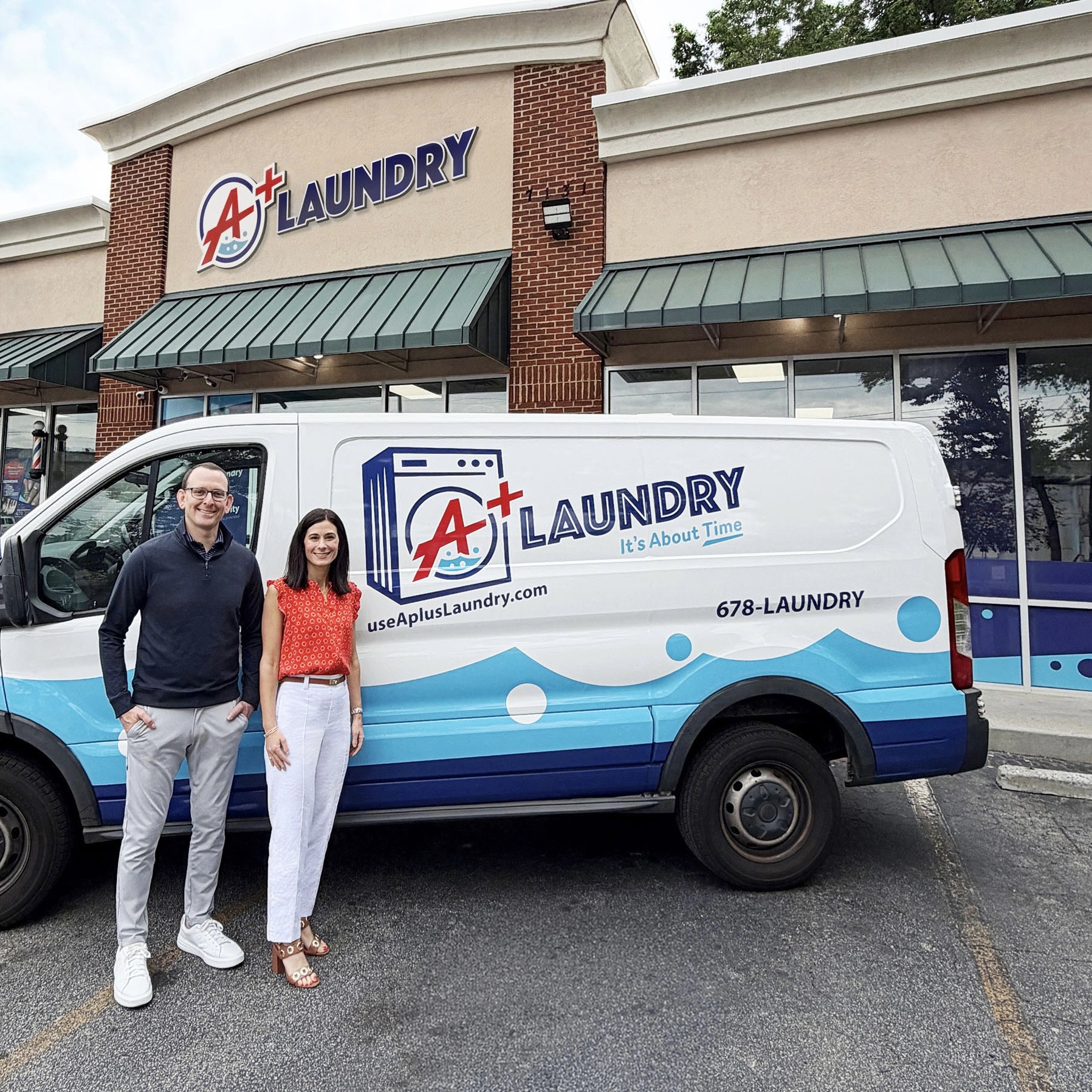
Amy Knopf and Avi Robbins spent their careers building other people’s businesses inside private equity. Now they’re building their own — and they picked one of the most unglamorous corners of the economy to do it: the corner laundromat.
The two co-founded A+ Laundry in Atlanta in February 2025, and 18 months in, they’re operating a retooled laundromat and a pickup-and-delivery service across a metro area with more than 300 competing laundromats. Their pitch isn’t just clean clothes — it’s an entirely rebuilt customer experience, backed by real estate instincts, manufacturing-grade operations discipline, and a bet that laundry, of all things, is ready for a tech-driven overhaul.
Knopf’s connection to the industry runs deeper than most operators’. Her family has run a commercial laundry business in Ohio for 95 years, started by her great-grandfather and still run today by her brother, cousin, and father. Before A+ Laundry, though, she spent 14 years as an owner and operator across office, retail, and multifamily real estate.
“I love this idea of taking something that everybody does, everybody needs — clean clothes — and finding a better way to deliver that,” she said.
Robbins came at it from manufacturing, running businesses for private equity firms for about 15 years, mostly launching new products in the medical and life science space. He and Knopf had known each other for more than a decade — their kids grew up together — and he was actually shopping for his own manufacturing business to buy when the two started talking seriously about laundry instead.
“Amy and I ended up thinking about laundry, and we spent a couple months evaluating the space together,” he said, drawn to what he called “the same stickiness factors” he liked about manufacturing, plus a pickup-and-delivery landscape just beginning to catch up to the broader convenience economy.
Once they’d settled on the industry, they didn’t wait for deals to come to them.
“We mapped out all the laundromats in Atlanta. So there’s 300 plus. We put them on a map, and we just started driving… walking in, leaving a business card, talking to attendants,” Robbins said.
Eventually someone called back — an owner who’d bought his laundromat a couple years earlier and discovered, too late, that it wasn’t the passive business he’d been promised.
“The equipment was breaking. It was about 20 years old, and so half the machines weren’t working,” Robbins said. The deal came together almost instantly: “We shook his hand on the sidewalk after he called his wife. It was like that, it was that easy.”
Closing was another story. Signed in May, the deal didn’t finalize until September — not because of financing or equipment, but the lease.
“We had the financing, we had everything lined up, and then we just had to keep delaying closing and closing and closing until we could get an acceptable lease with the landlord,” Robbins said.
It’s a risk he now flags for anyone evaluating a deal in this space:
“Making sure that you have the right amount of term, or you can go get it, or you can engage with the landlord that’s active… the leases is obviously very important, and it’s a big pain in almost every deal that we’ve looked at.”
Alongside the laundromat, A+ acquired a pickup-and-delivery operation that had run for two decades on paper routes.
“It started completely paper-based, right? They’re running paper routes, driving by homes,” Robbins said.
He’s since rebuilt it into a digital operation — online requests, optimized routing, integrated systems — freeing up hours he used to spend manually entering orders.
“I can now do with the tools that I’ve built… save literally hours a day of effort that we can spend buying, going out and finding new laundromats, training the team on new skills.”
The retool of the first store is where Knopf’s real estate background shows most clearly. Before touching anything, she and Robbins simply stood in the laundromat and watched.
“The first thing we did was we stood in the laundromat as it was before, and we watched the customer flow,” she said.
What they found was an attendant desk “tucked behind with basically your back facing the door” — no eye contact with arriving customers, no way to know someone had even walked in. They tore it out and started over.
“We moved the desk from where it was, and we positioned it right in front of the doors. So now our attendant sees every person that pulls up, goes opens the door, helps them carry laundry from the car.”
A new welcome center went in near the entrance, with the word itself mounted on the wall.
“We want people to see it, to feel it. We don’t want any guesswork about what it means to walk into our store,” Knopf said.
Robbins compared the old layout to something out of a bank:
“It’s this floating island where the attendant sits so that they can welcome you just like a concierge desk when you walk in.”
New equipment and fresh paint aren’t enough to change a neighborhood’s mind on their own, and Robbins is candid about the ongoing work of proving it.
“We still have to go out there and let the community know that we’re back,” he said. “We’re not the zombie mat that was there for the last five years.”
Knopf’s advice to anyone entering the business: don’t skimp on the marketing line.
“There is real marketing dollars that need to go into your pro forma.”
In practice, that’s meant bilingual story time with the local library inside the store and a planned cookout at a neighboring apartment complex — “we’ll have a grill and we’ll have music,” Knopf said. “We’re really integrating ourselves into the community.”
Staffing has evolved too. For the first four or five months, Knopf and Robbins fielded every call themselves, including the after-hours ones. Hiring a store manager, Juan, changed that.
“I still remember the day we hired the store manager, and I didn’t have to come in on Saturday anymore when there was a problem,” Robbins said.
Juan has since become the face of the store, freeing the founders to focus on sourcing the next acquisition.
Underneath the storefront, A+ Laundry runs on tools Robbins built himself — remote monitoring of vending supply levels, alerts when a customer’s wash cycle is finishing so an attendant can meet them at the machine. That focus on time is baked into the brand itself.
“Our tagline for A+ Laundry is, ‘It’s about time,’” Knopf said. “An extra hour of laundry is an hour they could’ve been doing something else… it’s about time how we can really create more of it for everybody.”
Eighteen months since founding the company, neither Knopf nor Robbins shows signs of slowing down.
“It just feels like the right moment to be starting this business,” Knopf said.
Her advice for staying that way:
“Day one, we start over each day. Be the best that you can be each day. Give it your all.”
Robbins’ rule has guided both the acquisitions and the customer relationships:
“Just listen. Whether that’s with your customer or even a potential acquisition target… everybody has their own story, and how you deliver the best experience for that person is different from the next.”
This episode is sponsored by Huebsch.

Related Posts
-
Full CycleThe Spin on Innovation
Innovation is one of the most overused words in business. Strip away the noise, and it’s something more practical — and more accessible — than most people assume.
The Spin on Innov…
12 min read -
Partner PerspectiveThe Next Frontier of Wash/Dry/Fold
The wash/dry/fold segment has become one of the fastest-growing revenue streams in the laundromat industry — and the data explains why.
The Next Frontier of Wash/Dry/Fold
The wash/d…
2 min read -
Full CycleCents Acquires Insight Systems, Adding Data and Reporting Tools for Laundry and Dry Cleaning Operators
Cents, a software, hardware and payments platform for the laundry industry, announced July 14 that it has acquired Insight Systems, a business intelligence and reporting platform for the garment care …
3 min read