Finding and Keeping Talent in a Service-Based Business
In a tightening labor market, service-based businesses are learning that culture, structure and empathy are the real keys to finding and keeping good people.
Finding and Keeping Talent in a Service-Based Business
In a tightening labor market, service-based businesses are learning that culture, structure and empathy are the real keys to finding and keeping good people.
Does it feel like there is a revolving door at your company? Is your employee turnover leaving you feeling dizzy? In today’s service-based economy, finding and keeping good people has become one of the most critical – and difficult – challenges for business owners. Tight labor markets, rising wages, shifting worker expectations and post-pandemic burnout have reshaped what employees want from their jobs. Few industries feel this more acutely than the laundry industry, where frontline employees shape nearly every aspect of the customer experience.
Unlike many other service-based business environments, laundromats operate at the intersection of hospitality, logistics and community service. Employees are not simply maintaining equipment; they are interacting with customers, handling personal items, solving problems and often serving as the human face of a brand. As automation increases across retail, the irony is that human connection has become one of the strongest differentiators in the laundry business.
Steven Nunez, founder of The Laundry Room in Orlando, Fla., knows this firsthand. Since opening his first store in August 2020 – at the height of the COVID-19 pandemic – Nunez has grown his operation to what he calls “three and a half stores”: two purpose-built locations in Orlando, one acquired store in Miami, and a fourth Orlando site under construction.
“I opened in COVID, literally at the peak of the pandemic,” Nunez said. “I was like, this might be bad. I don’t know if this is going to work.”
Despite the timing, the business took off. From day one, Nunez launched with self-service, wash-dry-fold, and pickup-and-delivery. “My vision from the beginning was always pickup-and-delivery first,” he explained. “The laundromats supported that, not the other way around.”
That vision had major implications for labor. Pickup-and-delivery requires reliability, consistency, communication and trust – qualities that cannot be automated. And as Nunez quickly learned, the success of a service-driven model lives or dies with the quality of its people.
Customer Service as a Differentiator Unlike traditional self-serve laundromats, Nunez built his model around fully attended stores. For him, labor is not just a cost, it’s a competitive advantage.
“I’m a true believer of 100% attended stores,” he said. “One of the best ways to separate yourself in not only this industry, but any industry, is customer service. The one thing that’s continued to dwindle over time is customer experience. It’s either not good or it’s not human. Both of those are problems.”
In an era where many laundromats are pushing toward unattended models and remote monitoring, Nunez intentionally moved in the opposite direction. He believes customers are willing to pay more and remain more loyal when they feel seen, supported and remembered. And that’s where solid talent comes in.
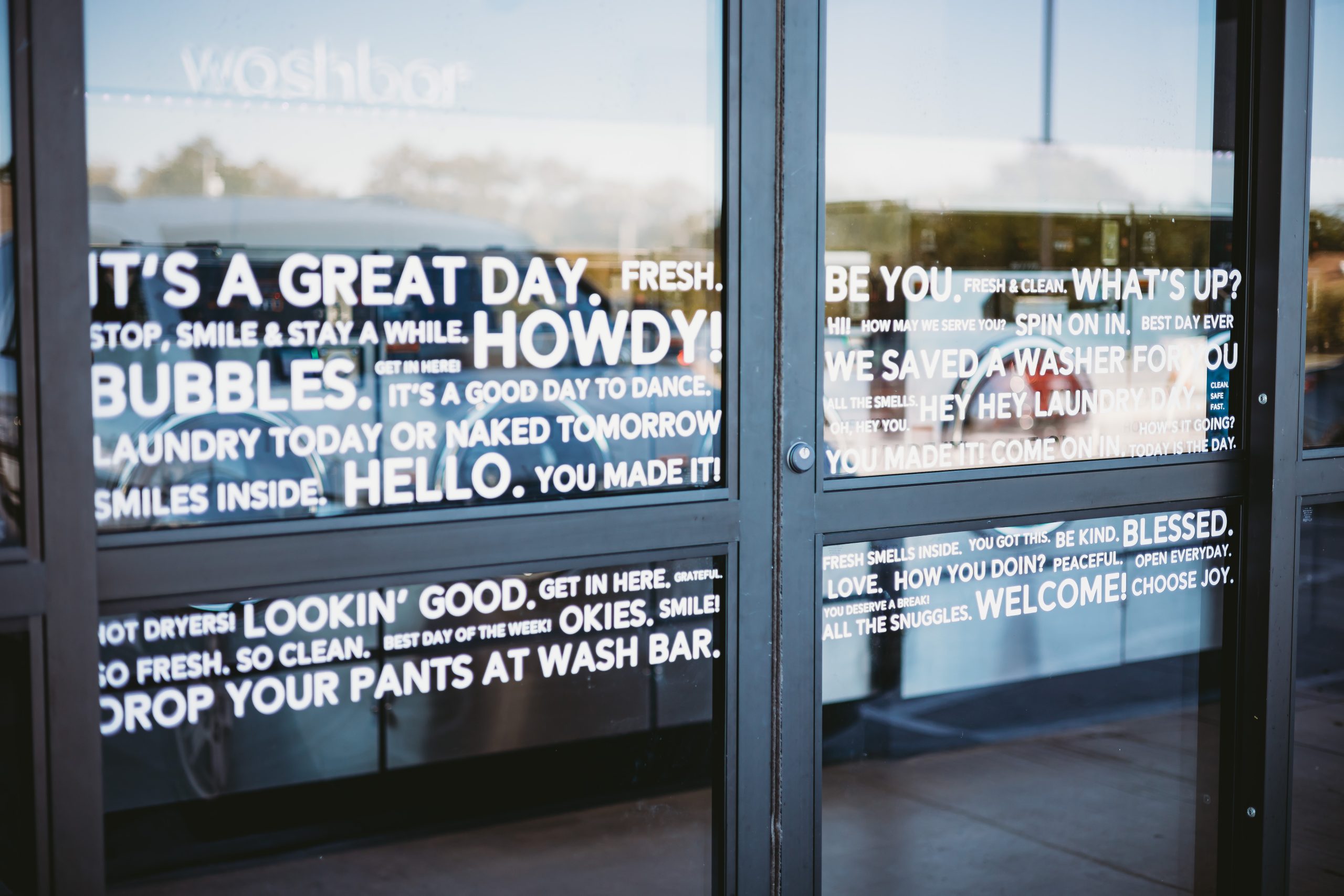
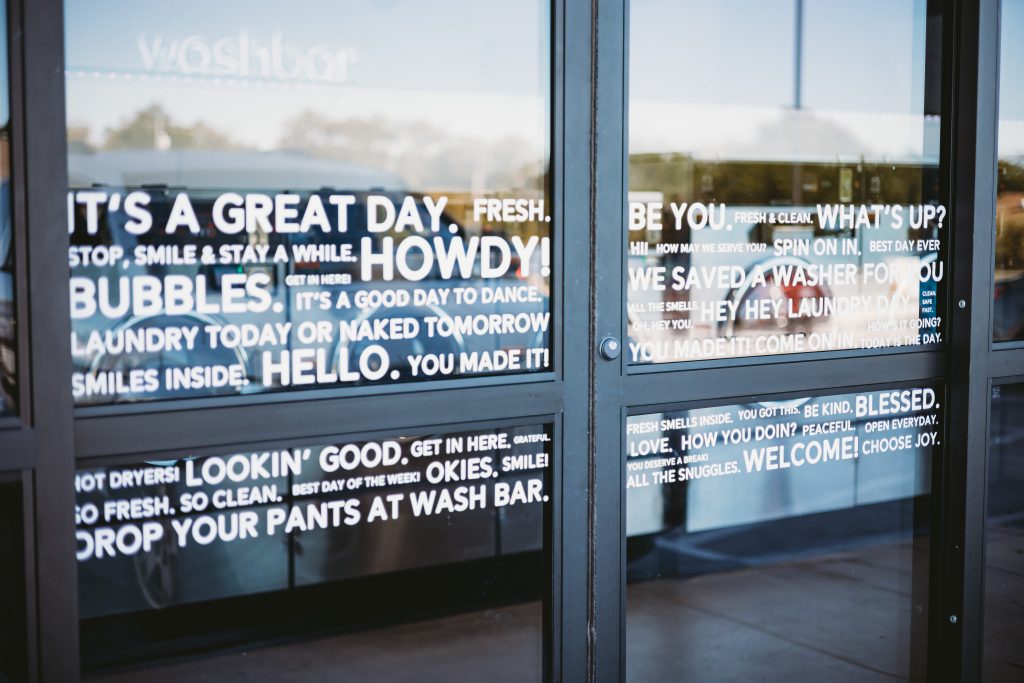
Hannah Chapman, owner and founder of Wash Bar Laundry and coach at the Laundry Advisors in Ardmore, Okla., sees the same dynamic from a unique angle. With four attended locations offering self-service, wash-dry-fold, and pickup-and-delivery, Chapman frames her entire business around one principle.
“Our mantra for everything is we’re in the people business, not the laundry business,” Chapman said. “We’re always people first and laundry second. That drives every decision we make.”
“Our mantra for everything is we’re in the people business, not the laundry business.”
Hannah Chapman
Chapman’s perspective is shaped by her background in healthcare, where she learned that technical competence is rarely enough on its own. Emotional intelligence, empathy and communication often matter more. “In healthcare, you learn very quickly that physical problems are often just presentations of what’s going on emotionally,” she said. “That’s where my empathy started.”
She applies that same mindset to customer interactions. For Chapman, laundromats are not just transactional spaces – they are social spaces.
“There are customers who come in and say, ‘I haven’t talked to anyone all day,’” she said. “We give them a place to connect. Bob comes every Tuesday because he knows Kayla will be there. That’s not a transaction – that’s a relationship.”
For other service-based companies, the push to deliver stronger customer experiences is reshaping how owners think about labor and often straining already tight margins. Constantine Anest, owner of Ethos Roofing & Restoration in Denver, Colo., said the demand for constant communication has fundamentally changed staffing needs in his business.
“Typically, this involves hiring project coordinators to maintain constant communication with clients, which increases payroll costs without adding revenue,” Anest said. “Skilled roofers don’t always know how to properly document projects, so business owners face a choice between losing good craftsmen and investing in dedicated customer service staff.”
That tradeoff has become increasingly common across service-based companies. Beyond customer communication, Anest pointed to retention and workforce shortages as two of the most pressing labor challenges facing small service businesses today.
“Retention challenges and the shortage of qualified roofers force companies to compete for the same specialists, leading to rising labor costs and reduced profit margins,” he said. “Fewer younger workers are entering the trades, and experienced craftsmen often either retire or start their own companies.”
As the labor pool tightens, many service-based companies are turning to technology and operational efficiencies to ease the burden. For Anest, digital tools play a growing role in keeping teams productive without expanding headcount.
“Generally, we look to technologies such as CRM systems and the automation of administrative tasks to reduce the workload on teams and increase efficiency,” he said. “Many companies also develop partnerships with subcontractors, but not every company can rely on this approach.”
Taken together, Anest’s experience reflects a broader reality for service-based businesses: delivering better customer experiences often requires more labor, not less – forcing owners to balance workforce investment with profitability in an increasingly competitive market.
Home service companies are another example of key service-based businesses facing labor challenges. For these companies, rising customer expectations are reshaping not only how services are delivered, but also how teams are built. Ryan Knoll, owner of Tidy Casa, which operates multiple locations across Arizona, says customer demands are now pulling businesses in two very different directions.
“Customers who don’t spend as much tend to want way more for way less,” Knoll said. “Higher income customers, on the other hand, want faster services that are easier to use from a self-serve perspective. Meaning, quick and easy online booking. They don’t want to talk to a human.”
“Higher income customers, on the other hand, want faster services that are easier to use from a self-serve perspective. Meaning, quick and easy online booking. They don’t want to talk to a human.”
Ryan Knoll
To meet both expectations, Knoll said Tidy Casa has had to radically customize its services and expand availability – changes that sound automated, but in reality require more people, not fewer.
“Essentially, we’ve had to TikTok our services,” he said. “Customize them for each individual, increase availability and allow people to book themselves without talking to a human.”
“Customizing a service and opening up availability means bringing in more people, teaching them how to follow a unique checklist for each job – think a trillion Starbucks coffee combos, but for house cleaning – while still maintaining that five-star service people expect,” he said.
Despite the growth of self-serve booking, Knoll said it has actually increased labor needs. “While online booking sounds like less people, the actual result is more people needed to follow up and correct or clarify things, route planners, customer service and more technicians in general,” he said.
Hiring, however, remains the biggest bottleneck. “The biggest labor challenge is not enough qualified candidates and fierce competition for the few that are around,” Knoll said. “We typically take in around 200 applications and will hire one – if we’re lucky.”
Even more striking, he added, “Only about 20% of the interviews booked have candidates show up. That’s an 80% no-show rate. They are ghosting us out here.”
To adapt, Knoll said Tidy Casa has focused on two main strategies: speeding up recruiting and adjusting pricing. “To win the battle for this small number of job candidates, we’ve had to increase our speed-to-lead and respond to applicants as fast as we would a customer,” he said. Automated interview booking, he says, resulted in “about 10 times the number of people we were able to hire.”
On the customer side, raising prices has helped align expectations with operational reality. “Charging more allows us to spend more on staff, which makes recruiting easier and makes it easier to deliver the higher quality service customers expect,” Knoll said.
Together, Knoll’s experience highlights a growing truth for service businesses: better customer experiences almost always demand more labor, more systems and more strategic investment, long before they deliver better margins.
The result is consistency.
“I’ve got people who’ve worked almost the same schedule for four years,” he said. “They don’t want to leave because they can build their life around it.”
Building a Solid Labor Structure Managing sub-$25-per-hour employees across multiple locations requires more than good intentions. It requires structure. Nunez designed his company with clear layers: a regional manager, store managers at each location, and tiers of attendants based on tenure and performance.
“My regional manager is my right hand,” he said. “She actually started as my first attendant. She grew into that role over time.” His corporate background heavily influenced this approach. Before launching The Laundry Room, Nunez spent 10 years in sales and leadership roles, managing teams in high-pressure, performance-driven environments.
“I use a lot of my leadership background, grooming entry-level people, working on soft skills, emotional IQ,” he said. “It’s the same format I used in corporate.” He is also unapologetically data-driven.
“A problem happens: Why did it happen? How do we prevent it? What’s the new process? Are we documenting that?” he said. “That’s how you scale.”
Chapman came to similar conclusions through trial and error. In her first year owning a laundry business, she cycled through 63 employees – when she only needed four.
“We didn’t have a people problem, we had a systems problem,” she said. “People are not the problem. Your system is the problem.” She rebuilt her hiring process around core values and objective scoring systems, eliminating gut-based decisions and focusing on cultural fit.
“We’re a unique industry, so we require unique questions,” she said. “If they don’t value cleanliness or kindness, they’re not going to stay and you don’t want them to.”
Today, Chapman documents processes across training, customer service, scheduling and leadership development. “You’ll be so much more profitable when you systemize,” she said. “Even if you’re not scaling, it eliminates headaches.”
Why People Stay
When it comes to retention, Nunez believes most departures fall into three categories. “People usually leave for one of three reasons,” he said. “They don’t like their boss. They don’t see a future. Or they don’t like the job.” To counter that, he focuses on autonomy and respect.
“Give them space to tinker, make mistakes and not walk on eggshells,” he said. “Lots of times people leave because they feel micromanaged or disrespected.” Nunez also draws directly from what he disliked in corporate life.
“I hated that I was just another body in a seat,” he said. “Everything was about numbers and performance. I try not to bring that jargon into my business. We’re a family. We’re a sports team – a high-performance sports team.”
Chapman approaches the same challenge through empathy. Rather than framing performance issues as disciplinary problems, she frames them as human conversations.
“Most people come in and say, ‘Your performance is terrible,’” Chapman said. “But I approach it as, ‘I see we’re not on track, tell me what’s going on.’ When you lead with empathy, most issues play out from there.”
She recalls a conversation with her operations director that completely changed how she viewed leadership.
“She broke down and said, ‘I’m just going through this right now,’” Chapman said. “And suddenly the problem wasn’t performance – it was life.”
Chapman also believes flexibility is one of the strongest retention tools in hourly work. “We’re sub-$20-an-hour people,” she said. “The greatest thing they want is flexibility.” Her team works in structured weekday and weekend shifts that allow employees to build their lives around predictable schedules.
“If you work Monday through Thursday, Friday is your day for appointments,” she said. “If you work weekends, you get Monday through Thursday.”
Paying More to Hire Less
Hiring, Nunez admits, is his least favorite part of running a business. “There’s nothing I hate more than hiring,” he said. “Going through applications, phone screens, interviews – it’s time-consuming and monotonous.” So instead of constantly replacing people, he invests more in the ones he has.
“You pay more, you do more with them, they usually stay in the seat longer,” he said. “It reduces headaches.” He also believes the laundry industry is being forced to rethink old assumptions about labor. “We’ve always thought we need the bottom of the labor pool,” he said. “But that’s not true. The business can support more – we just haven’t prioritized it.” With labor markets tightening and immigration uncertainty affecting hiring, Nunez believes laundry owners must rethink compensation, incentives and career paths.
“Starting pay, bonuses, pounds-per-hour incentives – those things are becoming more important,” he said. “The types of employees we bring in matter more than ever.”
Chapman added that emotional recognition can be just as powerful as financial incentives. At Wash Bar, every employee receives a welcome gift, handwritten notes from managers and recognition for birthdays and anniversaries.
“People want to feel needed, wanted and appreciated,” she said. “I gave a new hire a welcome gift and she started crying. She said, ‘I’ve been working for 45 years and I’ve never gotten a gift on the job.’ It cost me $10 – but it meant everything to her.”
Culture Is the Real Strategy
For both operators, retention is not about perks or slogans. It is about relationships, respect and long-term vision.
“People don’t leave relationships, they leave transactions,” Nunez said. “If they feel like they have a future, if they’re respected and if they’re challenged, they stay.”
Chapman echoes that belief. “We’re in the people business, not the laundry business,” she said. “Every decision – titles, hours, flexibility – it all comes back to people.”
In an industry often viewed as low-margin and transactional, their experiences point to the same conclusion: the businesses that treat labor as a strategic asset, not just an expense, will be the ones best positioned to grow.
“We’re running a business, and we have goals,” Nunez said. “But at the end of the day, if you build a real team, not just a workforce, everything else gets easier.”
We use cookies to ensure that we give you the best experience on our website. If you continue to use this site we will assume that you are happy with it.
Functional
Always active
The technical storage or access is strictly necessary for the legitimate purpose of enabling the use of a specific service explicitly requested by the subscriber or user, or for the sole purpose of carrying out the transmission of a communication over an electronic communications network.
Preferences
The technical storage or access is necessary for the legitimate purpose of storing preferences that are not requested by the subscriber or user.
Statistics
The technical storage or access that is used exclusively for statistical purposes.The technical storage or access that is used exclusively for anonymous statistical purposes. Without a subpoena, voluntary compliance on the part of your Internet Service Provider, or additional records from a third party, information stored or retrieved for this purpose alone cannot usually be used to identify you.
Marketing
The technical storage or access is required to create user profiles to send advertising, or to track the user on a website or across several websites for similar marketing purposes.